

The 90-Day Fluency Habit
Turn French into a habit that finally sticks.
One guided session of about 15 minutes a day to listen, write, remember and use everyday French.
Sécher les cours
/seʃe le kuʁ/to skip class / miss school.
▶ ListenFamilierJ’ai séché les cours cet après-midi pour aller au cinéma.
✍ Writing exercise
🎯 Mystery Word
💡 Show hintYou want to learn French, but you don't know where to start.
If any of these situations sound familiar, the workbook gives you a clear 15-minute routine to follow.
You took some French in school and most of it has faded.
You remember a few words and expressions, but it all feels fuzzy now. You know you could pick French back up, yet every program you find feels intimidating. What you want is an easy way back in, without having to crack open a 400-page grammar book.
You've tried Duolingo and you're not really learning anything you can use.
You know the colors, the animals, and the days of the week. But when you want to say something real, such as talking about your day or writing to a French friend, the words just aren't there. The exercises feel abstract, and nothing really sticks.
You've started plenty of courses and finished none of them.
You open an app, keep at it for three days, then drop off. You download an 80-page PDF and never come back to it. What you need is a format that's short enough and varied enough to keep you going for three months.
A look at what's waiting for you.
You'll find a few colorful idioms, but mostly the small turns of phrase French speakers use all the time: the kind that make the difference between correct French and French that actually sounds right.
In 15 minutes, 5 guided exercises help you remember and reuse one expression.
Each short session guides you through listening, repeating, writing, and playing with the day's expression, so you practice recognizing and using it.
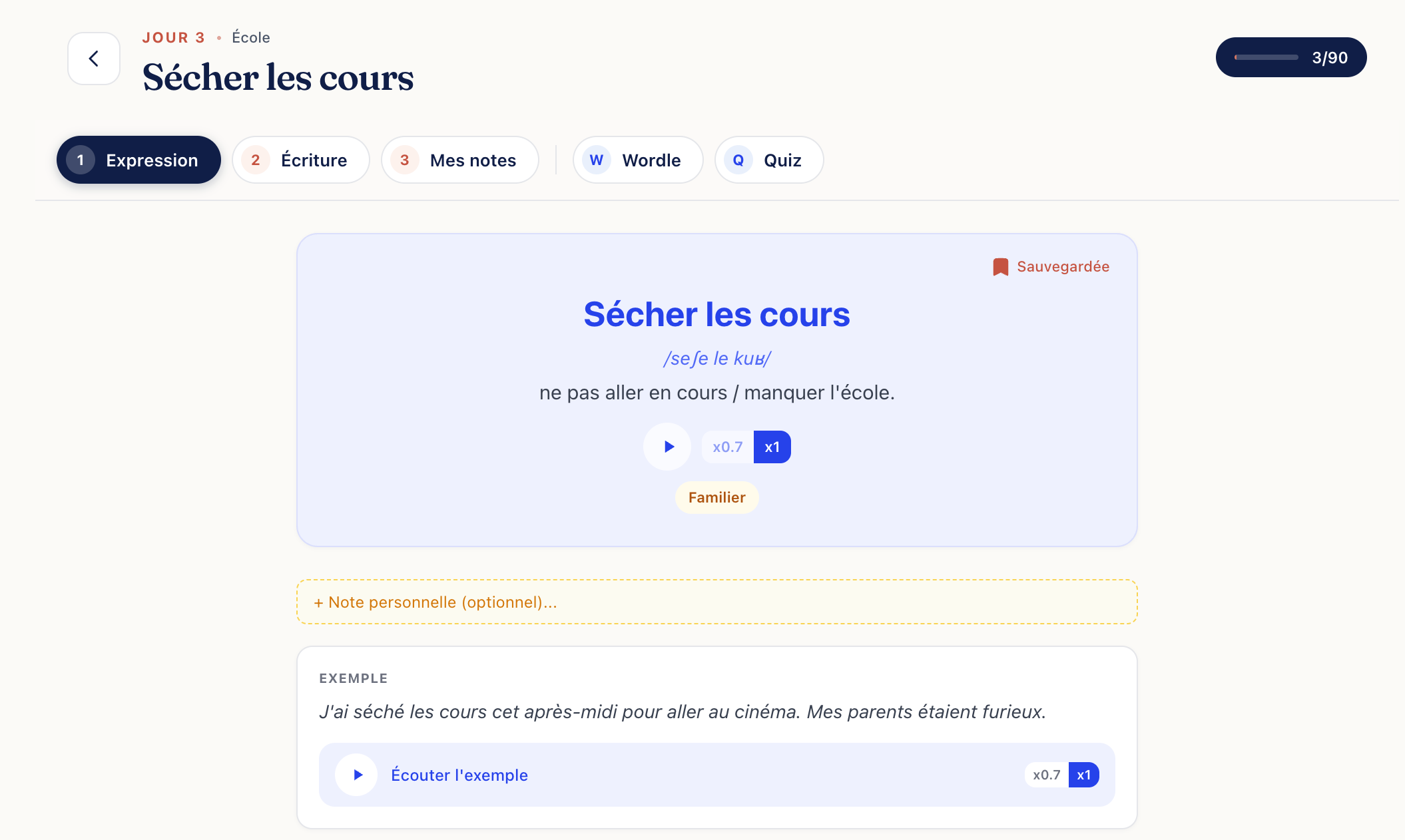
An expression French speakers use in conversation.
Each day, you meet an expression French speakers actually use, with audio, phonetics, its register (informal or formal), and an example that shows you when to use it.
- Native audio at normal or slowed speed (0.7x)
- A definition in simple French and a real-life example
- Save the expression to revisit later
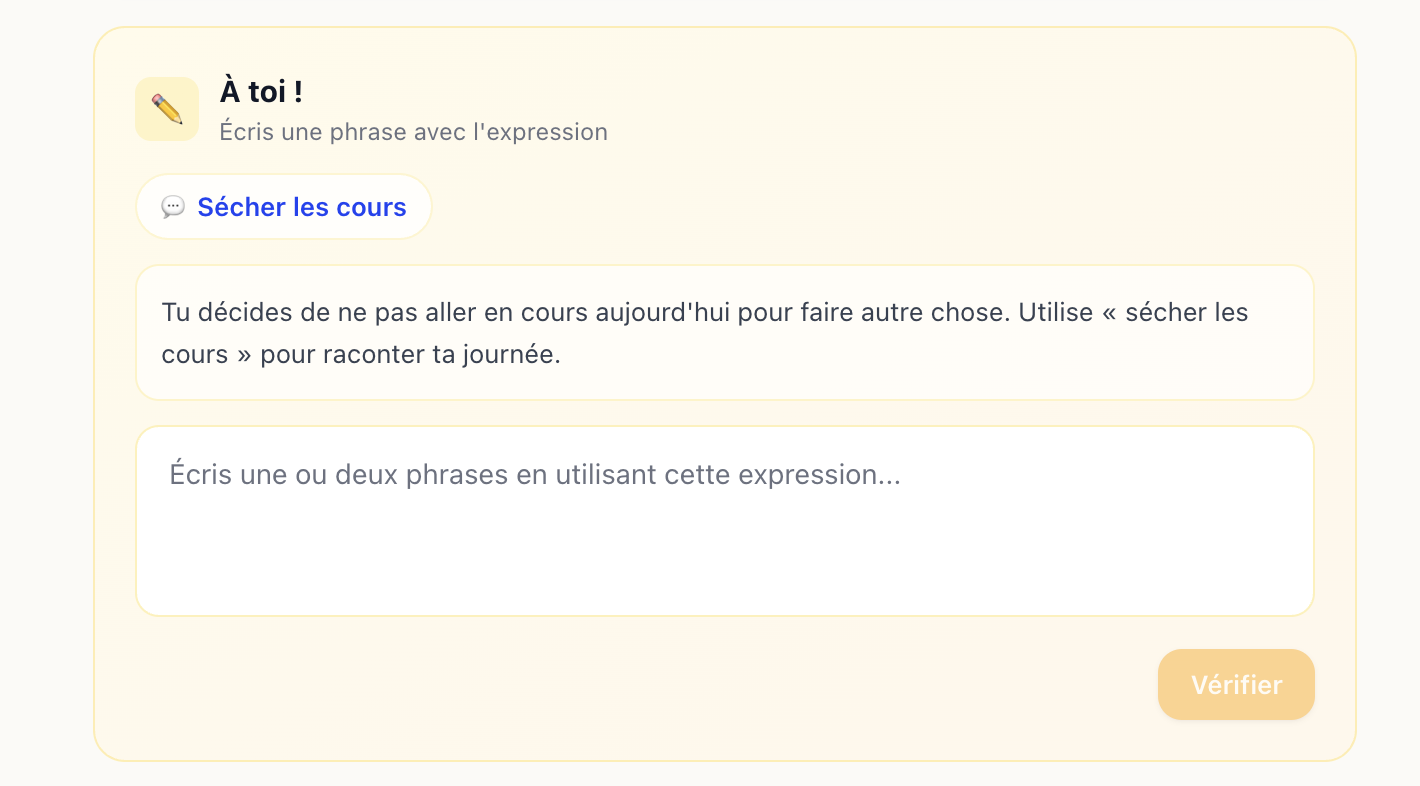
You use it in a sentence of your own.
You get a specific situation and write a short sentence using the expression. Writing your own example helps turn recognition into recall.
- A real situation, not a fill-in-the-blank
- Instant feedback on whether you used the expression correctly
- Two minutes flat, so it fits right into your evening routine
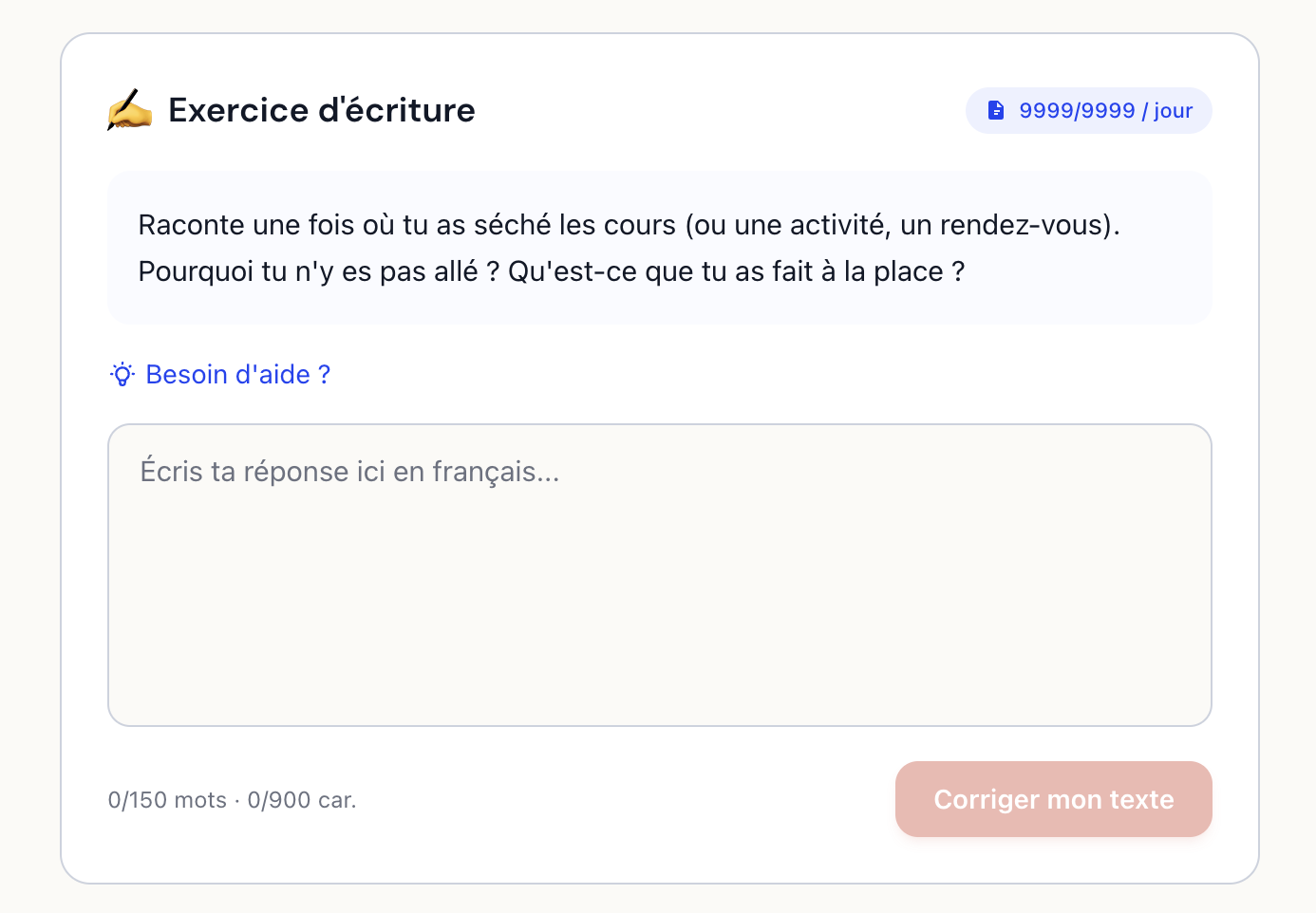
A story to tell, with detailed feedback on every mistake.
The main exercise is an open-ended prompt: write 100 to 150 words in French, tell a story, share your opinion, or make something up. The example below shows exactly what kind of feedback you'll receive.
- Prompts designed to get you reusing the expression naturally
- A “Need help?” hint when you're not sure what to write
- Word and character counter so you can gauge your answer
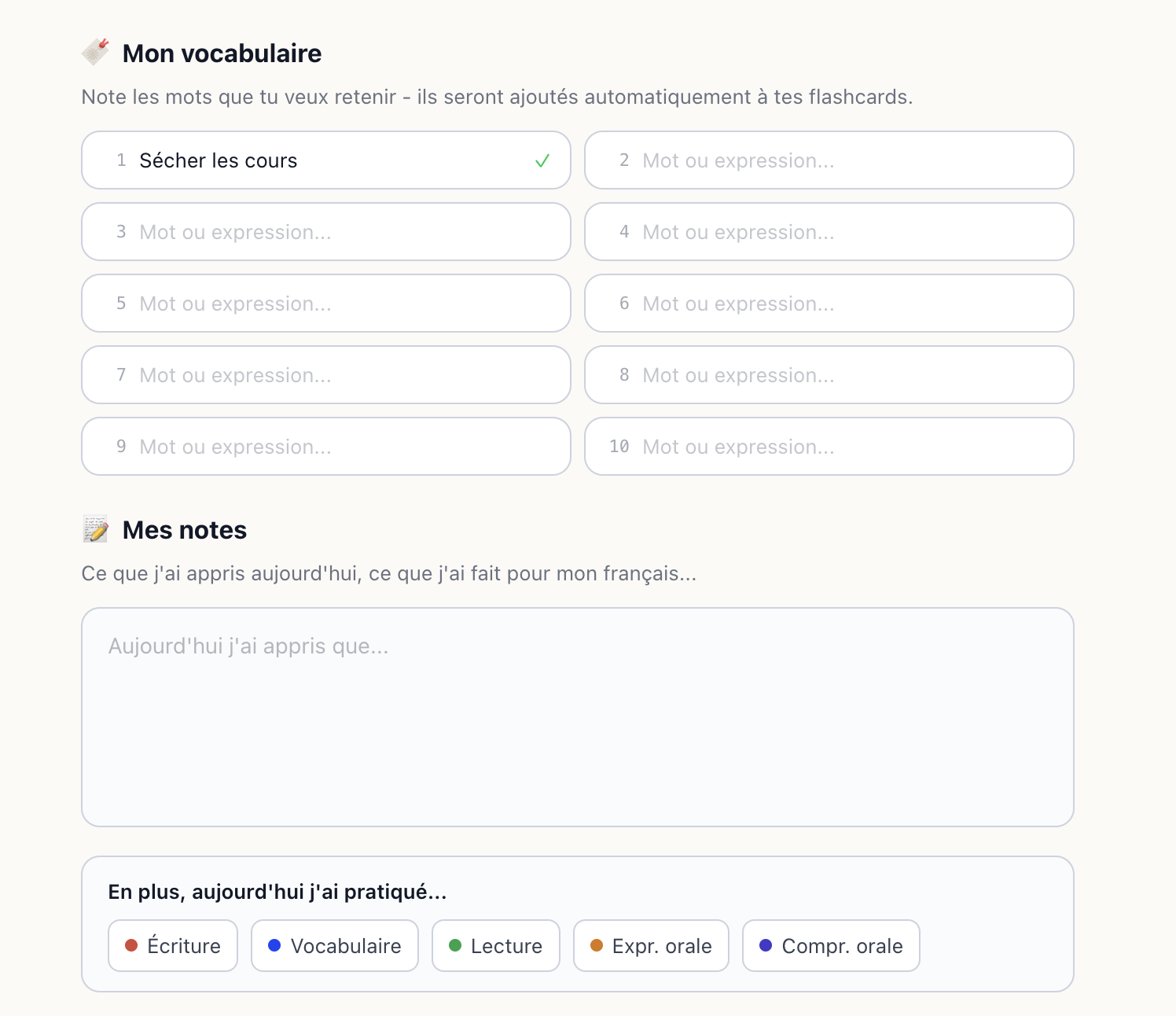
Your own personal notebook, alongside today's expression.
During the session, you can jot down other words or phrases you want to remember, along with what you took away that day. The vocabulary you save goes straight into your review flashcards.
- Up to ten words or expressions to remember each day
- Personal notes: “what clicked for me today”
- Check off the extra skills you practiced, such as reading or speaking
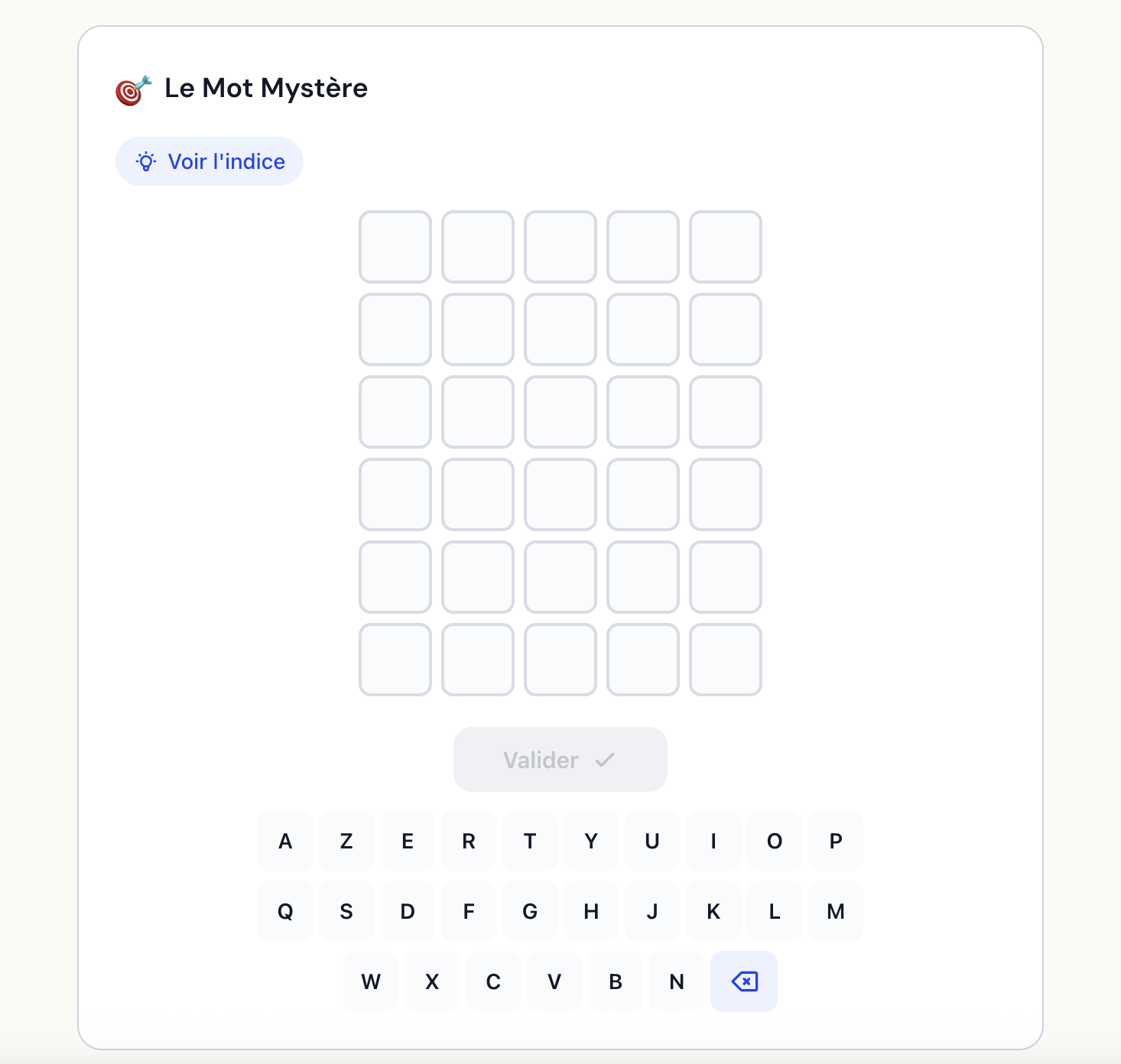
Finish with a short word game that brings the day's expression back into play.
Each session ends with a Wordle-style game connected to the day's expression. A hint is available if you get stuck.
- One mystery word a day, tied to the expression
- A hint when you need one
- A quick, playful way to revisit the day's vocabulary
15-day money-back guarantee, no questions asked
Jean reviews each of your sentences.
When you write, Jean spots your mistakes, suggests natural phrasing, and explains each correction in simple French. The example below is shown in English.
Quand j'avais 16 ans, j'ai séché les cours un fois pour aller à le cinéma avec ma copine. Mes parents étaient très fâché quand ils savaient, mais c'était une bonne journée.
Quand j'avais 16 ans, j'ai séché les cours une fois pour aller au cinéma avec ma copine. Mes parents étaient très fâchés quand ils l'ont appris, mais c'était une bonne journée.
Your mistakes, explained
Jean identifies grammar, conjugation, preposition, and agreement issues, then suggests a correction for each one.
The natural phrasing
Jean suggests a more natural way to phrase your idea, instead of simply marking it “right” or “wrong.”
The explanation
A short explanation in simple French, so you understand the rule instead of just memorizing it.
How your French changes, from the first week to the last.
You get back into the habit of writing in French.
In the first weeks, you rebuild a habit that had gone dormant. Your sentences are short, sometimes clumsy. And that's exactly what you want. The corrections zero in on the agreement errors and small prepositions that have been tripping you up for years.
Your sentences get longer, and you write with less hesitation.
By the second month, you can feel yourself writing faster and more freely. The expressions from the first weeks start showing up in your own sentences without you having to think about it. You start catching some of your own mistakes before you hit submit.
Writing gets easier, and you notice which phrases sound right.
Over 90 days, you meet 90 everyday expressions and reuse them in sentences of your own. Your messages and replies gradually become more fluid.
Eleven bonus resources, released as you progress through the 90 days.
Print them or fill them in on screen. They round out the workbook when a theme is worth exploring further. Tap or hover over any card to see when it unlocks.
Printable workbook
Day 1Editable workbook
Day 1French toast recipe
Day 730 essential verbs
Day 1410 common mistakes
Day 35Expanded vocabulary
Day 42Tarte tatin recipe
Day 49Adjectives of emotion
Day 56Informal French
Day 6310 false friends
Day 70Brand name or common noun?
Day 77“The best investment I've made in my French.”
- NicholasMy French workbook has become a kind of personal diary. My French is still A2, but I'm proud of my progress.
I like the approach, and the workbook is well structured and easy to follow. The best investment I've made in my French.
Is this workbook right for you?
The workbook focuses on daily writing and sentence-building, while my other courses place more emphasis on listening and speaking. Check the details below to see whether it matches your goal.
The workbook is for you if...
You're starting French or coming back to it- You're a beginner in French, or you studied French a long time ago and you want to ease back into it.
- You want a short, doable routine instead of an intimidating 400-page textbook.
- You want to learn words and expressions that are useful in everyday conversations, not isolated vocabulary.
- You want to write your first sentences with clear feedback that helps you improve without feeling judged.
The workbook isn't for you if...
If you need something more advanced, I'd rather tell you now- You're already comfortable in French and you want to understand native French speakers at their natural pace.
→ Check out 360 French Immersion instead - You're preparing for a specific exam (DELF, TEF, TCF). That's not what the workbook is built for.
- You want live video classes with a teacher in real time, not a routine you do on your own.
→ Check out one-on-one coaching
The 90-Day Fluency Habit
$89 once and the workbook is yours forever. That comes to less than $1 per guided session.
- 90 guided daily sessions, about fifteen minutes each
- Audio at two speeds (normal and slowed down)
- Detailed feedback on your own sentences
- A daily French Wordle
- Quizzes, crosswords, spaced-repetition flashcards
- Cultural notes on every theme
- 11 bonus PDFs unlocked as you go
- Progress tracking and personal stats
15-day money-back guarantee, no questions asked
Try the workbook for two full weeks. If it's not the right fit, send me an email and I'll refund you. No explanation is needed.
A few things you might be wondering.
What if I miss a day, or even several?
No problem. Just pick up where you left off. What matters is coming back regularly, not maintaining a perfect streak.
What level of French do I need to start?
The workbook is for beginners and people returning to French after a long break. If you can read the French alphabet and recognize a few common words, you can get started. The first days cover simple everyday themes, even if you have not practiced in years.
Who corrects my sentences?
Jean, Elisabeth's AI assistant, reviews your sentences. You get a suggested correction and a detailed explanation directly below each sentence. It isn't just an automatic score: the feedback explains what may need changing and why.
How is this different from 360 French Immersion?
360 French Immersion focuses on listening to native speakers, pronunciation, and spoken practice. The workbook starts with simple 15-minute writing sessions that help you build your own sentences. You can take either course first, depending on the skill you want to practice.
Is this a subscription, or a one-time purchase?
It's a one-time purchase with lifetime access. You pay $89 once, and the workbook is yours forever, with no automatic renewal or recurring charge.
What if the workbook isn't right for me?
You have a full fifteen days to try it. If you decide it isn't the right resource for you, send me an email and I'll refund you in full. No explanation is needed. I'd rather this workbook end up in the hands of people who'll actually use it.
How long does each exercise really take?
Most sessions take 12 to 18 minutes, depending on whether you spend more time on the cultural note, replay the audio, or write a longer answer.
your French could already feel different.
Start your first 15-minute session today. Tomorrow, the next one will be ready.
Start The 90-Day Fluency Habit Course made with ❤️ by Elisabeth & Mathieu, in France 🇫🇷.